

Advantages of lightweight bottles
Glass bottles and jars have excellent comprehensive functions, but also have the disadvantages of being easy to break and heavy. In recent years, with the emergence of some new packaging containers, glass packaging containers are facing competition from metal, polymer, paper and other materials. Therefore, as glass bottles and jars are widely used in the packaging industry, it has become the future development direction and trend to reduce manufacturing costs, improve quality grades and enhance competitiveness with other types of packaging materials while meeting their packaging requirements.
Lightweighting of glass bottles and jars is the main way for the glass packaging industry to reduce manufacturing costs. Lightweight bottles refer to bottles that are made by reducing the wall thickness and weight while maintaining the capacity and strength of glass containers.
The production of lightweight bottles has the following advantages.
(1) It can save the consumption of raw materials. The glass industry is a large energy consumer. Whether it is fueled by coal, heavy oil, natural gas or electricity, it consumes a lot of energy. In the modern society with tight energy, producing as many products as possible with limited energy will undoubtedly greatly reduce its manufacturing costs, enhance the competitiveness of products, and have the social benefit of saving energy.
(2) It can increase the machine speed, speed up production, and improve the transparency of the bottle. Modern glass bottles and jars are mostly produced by mechanized high-speed molding, which reduces the weight of the bottle, speeds up the molding speed, and obtains more output.
(3) It can reduce the transportation costs of each circulation link. In the long-distance transportation link of multiple means of transportation, lightweight glass bottles and jars will reduce transportation and circulation costs, and reduce a certain burden on producers, users and consumers.
Definition of lightweight bottles
At present, there are still no unified regulations and standards for lightweight bottles in the world.
The "Access Conditions for Daily Glass Industry" stipulates that the lightweight degree of lightweight glass bottles and jars shall not exceed 1.0.
The above formula is proposed by the same industry in the world. Different countries in the world have different index values for full capacity.
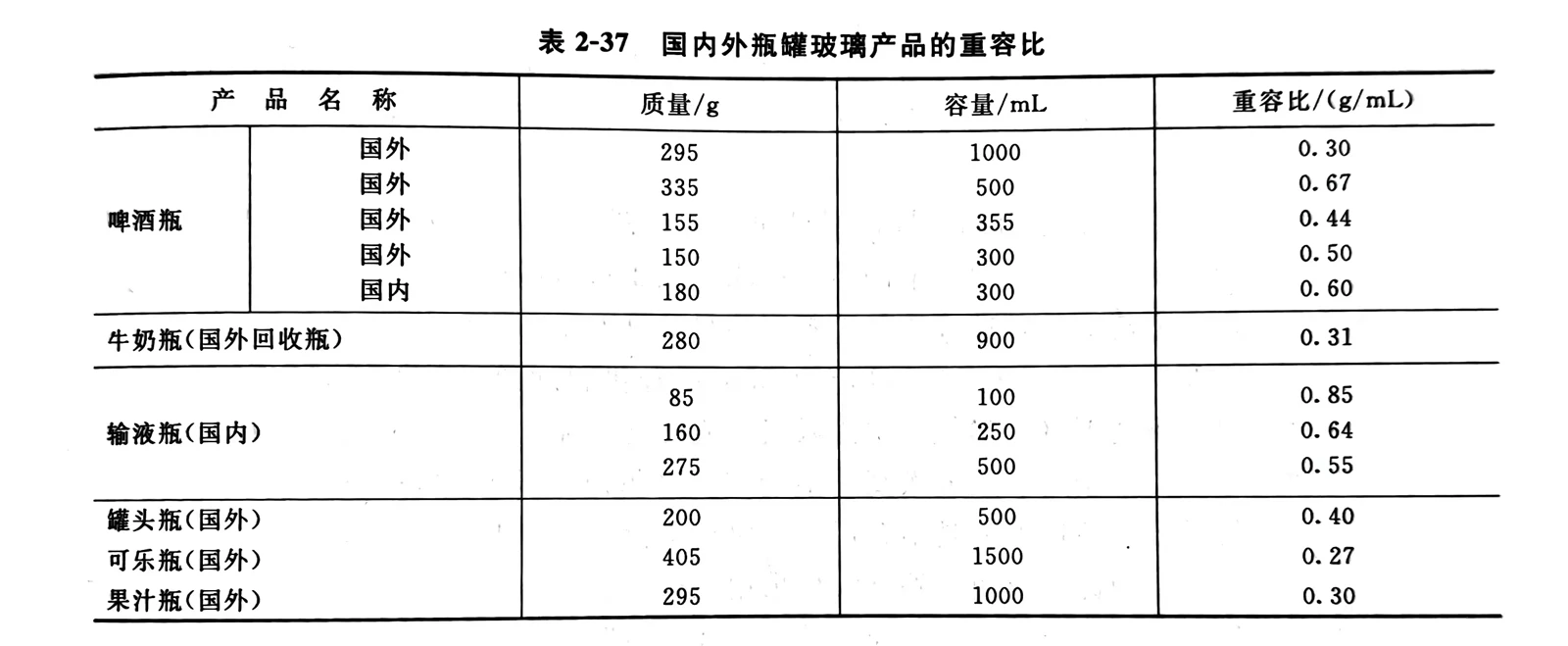
The lightweighting of glass packaging is to reduce the weight-to-volume ratio of glass bottles under the condition of ensuring certain strength, with the aim of improving its greenness and economy. The weight-to-volume ratio of bottle glass refers to the ratio of the weight to the volume of the bottle, that is, the weight of the bottle per unit volume, that is, the amount of glass used per unit volume of the bottle itself. The weight-to-volume ratio is a measure to evaluate the mass of glass bottles and jars of the same volume. The weight-to-volume ratio varies according to the capacity and purpose of the bottle. The weight-to-volume ratio of lightweight bottles is generally 0.15~0.8. The weight-to-volume ratio of pressurized recycling bottles is larger, and that of normal pressure bottles is smaller. In addition, the smaller the bottle, the larger the weight-to-volume ratio. Lightweight bottles have a small weight-to-volume ratio, relatively thin bottle walls, and light weight. The average wall thickness of a measuring bottle is 1.0~2.5mm. Lightweight bottles are mainly used as disposable bottles.
2.6.2 Definition of lightweight bottles
At present, there is still no unified regulation and standard for lightweight bottles internationally. Definition of lightweight bottles: Lightweight degree L 0.44X bottle weight full mouth capacity (0.810)
The "Access Conditions for Daily Glass Industry" stipulates that the lightweight degree of lightweight glass bottles and jars shall not exceed 1.0.
The above formula is proposed by the same industry internationally. Different countries in the world have different index values for full mouth capacity.
The lightweighting of glass packaging is to reduce the weight-to-volume ratio of glass bottles while ensuring a certain strength, in order to improve its greenness and economy. The weight-to-volume ratio of bottle glass refers to the ratio of the weight to the capacity of the bottle, that is, the weight of the bottle per unit capacity, that is, the amount of glass used per unit capacity of the bottle itself. Weight-to-volume ratio is a measure of the quality of glass bottles and jars of the same volume. The weight-to-volume ratio varies according to the capacity and purpose of the bottle. The weight-to-volume ratio of lightweight bottles is generally 0.15~0.8, the weight-to-volume ratio of pressurized recovery bottles is larger, and the weight-to-volume ratio of normal pressure disposable bottles is smaller. In addition, the smaller the bottle, the larger the weight-to-volume ratio. Lightweight bottles have a small weight-to-volume ratio, relatively thin bottle walls, and light weight. The average wall thickness of a measuring bottle is 1.0~2.5mm. Lightweight bottles are mainly used as disposable bottles.
Glass composition of lightweight bottles
For lightweight bottle glass, both domestic and foreign countries basically
The international general material formula is slightly changed. The chemical composition of general bottle glass is basically Na20-Ca0-SiO2 system, and lightweight bottle glass focuses on increasing strength. Increase the content of network formers in the composition to make the glass structure more compact. The charge of the oxide ions introduced in the composition should be high and the ion radius should be small. From the statistical changes in the chemical composition of lightweight bottle glass in the United States, only slight adjustments have been made. The purpose of the adjustment is mainly to shorten the melting and clarification time, improve the quality of glass, and adapt to the requirements of high machine speed.
Whether the designed glass composition is suitable for the production characteristics of lightweight bottles is mainly measured from the following aspects:
1 Improved chemical stability of glass;
2 Increased machine speed;
3 Reduced batch material cost;
4 Melting and clarification characteristics are similar to general bottle glass;
5 Reduced thermal expansion coefficient of glass, increased thermal stability of glass, thereby reducing cold explosion phenomenon.
Since the glass weight of the lightweight bottle drop is lighter than that of the ordinary bottle with the same capacity, and the capacity of the primary bubble is large during the molding process, the heat transfer is faster, which hinders the flow and distribution of the glass liquid in the blank and easily causes uneven distribution of the glass bottle wall. Therefore, from the perspective of molding, the machine speed should be increased. The chemical composition of some domestic lightweight glasses is shown in Table 2-38.

In the glass composition, in order to save the amount of soda ash, an appropriate amount of Li2O introduced by lithium mica is generally used to replace Na2O, which accelerates the glass melting process, reduces the viscosity and surface tension of the glass, and accelerates the clarification and homogenization of the glass. In addition, adding trace additives such as slag containing elements such as tungsten and vanadium to the glass composition can accelerate the formation of silicates, and has the advantages of easy melting, good clarification effect, stable process performance, and significant energy saving and consumption reduction effects.