

Forming method of bottle glass
The forming of bottle glass has gone through the development process from manual forming, semi-automatic forming to automatic forming. At present, it has reached the level of full automatic control by computer. At present, the forming of bottle glass mainly adopts the molding method, using the blow-blowing method to form small-mouth bottles and the press-blowing method to form wide-mouth bottles. The production of modern bottle glass widely adopts automatic bottle making machines for high-speed forming. There are many types of automatic bottle making machines, among which the determinant bottle making machine is the most commonly used. The determinant bottle making machine has a wide range of bottle glass production and great flexibility, and is gradually developing towards multi-unit, multi-drip mechatronics and intelligent control. All of this has significantly improved production efficiency.
Types and development of bottle making machines
There are many types of bottle making machines, such as Owens bottle making machine, automatic milk bottle machine, automatic press-blowing machine, Linqu machine, Roland bottle making machine, bubble blowing machine, gall blowing machine, cup blowing machine, cup pressing machine, determinant bottle making machine, Haiye bottle making machine, etc.
The Owens bottle making machine was introduced in 1905. It is the earliest automatic molding machine that uses suction molding. With the emergence of the drip feeder in 1923, various molding machines that use this method to feed materials have been introduced one after another. Such as automatic bottle making machines, automatic press-blow machines, pouring machines, Rolande bottle making machines, bubble blowing machines, gallbladder blowing machines, cup blowing machines, etc. In order to continuously load materials, the mold of this type of molding machine rotates with the workbench, so it is called a rotary table molding machine.
The Linqu machine is an early automatic molding machine used in my country. It is pneumatic and uses the blow-blow method to produce small-mouth bottles. my country imitated the Linqu machine and made a pneumatic six-mold bottle making machine (equivalent to the Linqu 10 machine). At present, there are still a few small glass factories in my country that use this molding machine, but it will eventually be replaced by the determinant bottle making machine.
The Rolande S10 bottle making machine was first successfully trial-produced by the Federal Republic of Germany in 1968 and is a more advanced rotary table bottle making machine. It is completely mechanically driven and suitable for producing small-mouth bottles by the blow-blow method. my country first introduced this type of bottle making machine from Belgium, and then copied several models such as DG111 and BLZ10. Figure 2-26 shows the structure of the Roland S10 bottle making machine.

The line-type bottle making machine (hereinafter referred to as the line-type machine) was introduced in 1925. It consists of several identical units (sections) in parallel. Each unit (section) can be regarded as an independent and complete molding machine. It is called IS (individual section) bottle making machine abroad (the structure of an individual unit is shown in Figure 2-27). It has the following characteristics.
(1) The line-type bottle making machine is composed of identical units. Each unit has its own timing control mechanism and can be started and stopped independently without affecting other units. This is not only convenient for replacing molds and repairing machines, but also when the output of the glass melting furnace decreases, the number of operating units can be reduced for production.
(2) The mold does not rotate. In order to continuously load the materials, each unit has its own material receiving system or shares a distributor.
(3) The production range is wide. Small-mouth bottles can be produced by the blow-blow method, and large-mouth bottles can be produced by the pressure-blow method. Each unit can also form products of different shapes and sizes (the quality and machine speed of the products should be completely consistent, and the material shape should be similar).
(4) The formed bottles and cans have good glass distribution, especially the various bottles and cans produced by the pressure-blowing method, with uniform wall thickness, which can achieve lightweight glass bottles and cans.
(5) The main operating mechanism of the row machine does not rotate, the machine moves smoothly, and the operating conditions are good.
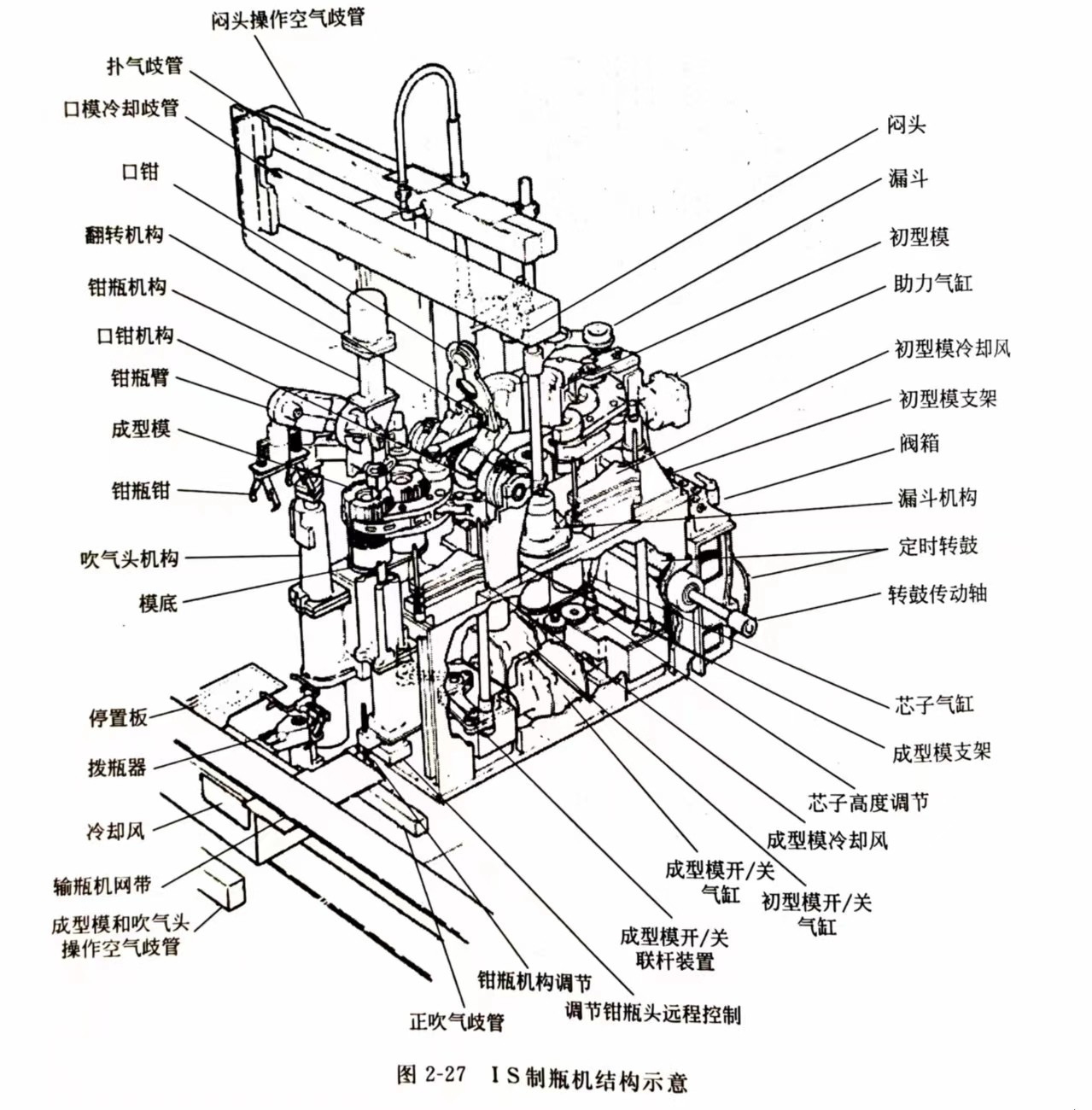
Because the row machine has the above characteristics, it is widely used in countries around the world and has become the mainstream of bottle making machines. The row machines produced by Emhart Company in the United States include E type, F type, EF type and AIS type. E type is the original model, and later it was gradually improved and developed into F type, EF type and more advanced AIS type. The number of groups has developed from the original 2 groups, 3 groups, and 4 groups to 5 groups, 6 groups, 8 groups, 10 groups, and 12 groups. The dripping material has developed from a single drop to a double drop and even a triple drop. The action mechanism of the row machine is driven by compressed air and can be independently controlled by an electrical valve box. Some mechanisms are also driven by servo motors. They all receive signals from the electronic timing control system and perform coordinated bottle forming actions according to the set program.
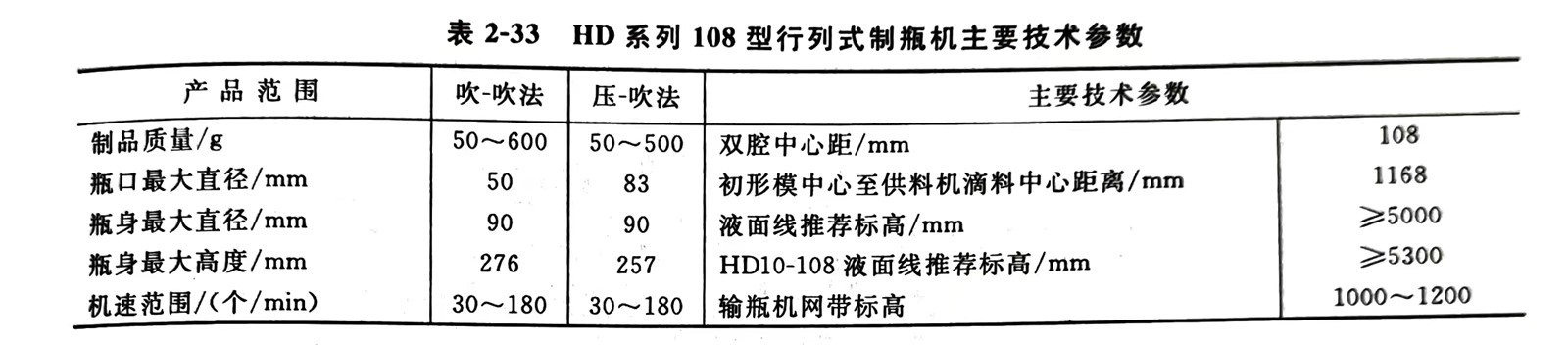
The QD row bottle making machine is a pneumatic, single-drop glass bottle automatic forming machine, and the HD row machine is a pneumatic, double-drop glass bottle automatic forming machine. Both can be used for blow-blow and pressure-blow operations. It can produce large-mouth bottles and small-mouth bottles of various calibers, and can meet the needs of glass bottle production lines with different capacities. As shown in Figure 2-28, the appearance of the HD series 108-type columnar bottle making machine, the center distance of the double cavity is 108mm, there are 4 types of models: HD4-108, HD6-108, HD8-108, and HD10-108. This bottle making machine adopts a variety of servo mechanisms and new technologies to improve the stability and reliability of the whole machine operation, and play a role in energy saving and consumption reduction. The main technical parameters are shown in Table 2-33.

Blow-Blow Method for Making Small-mouth Bottles
The so-called blow-blow method is to perform the first blowing in the primary mold to form the mouth and blow it into a prototype, and then transfer it to the molding mold for the second blowing. According to different feeding methods, there are two types of blow-blow molding: vacuum suction and drip feeding. The molding process is shown in Figure 2-29.
(1) Feeding of glass liquid The feeding channel is a closed channel built with refractory materials. The glass passes through this channel from the tank kiln operation part to the bowl of the feeder. The feeding channel consists of a cooling part and a homogenizing and regulating part. The glass liquid reaches the required temperature for molding through precise regulation in the feeding channel. Its structure is shown in Figure 2-30.
1 Cooling of glass liquid The temperature of the glass liquid flowing out of the working pool is too high (the viscosity is too low) and is not suitable for molding operations. It should be reduced to a certain temperature. Therefore, the glass liquid needs to be cooled. The cooling at the feeding channel is local. To reduce the overall temperature of the glass liquid uniformly, cooling adjustment must be made. The function of the cooling section is to cool and heat the molten glass after it flows out of the tank kiln so that the molten glass reaches the average temperature required for the molded product.
If the temperature of the molten glass is uneven, the flow of the molten glass in the feed channel will be uneven, and the high temperature part will be
The flow is fast, and the low-temperature part moves slowly, forming a stationary layer or dead corner, which leads to crystallization.
The cooling of the glass liquid in the feed channel is mainly carried out in the cooling part connected to the working pool. The quality of cooling mainly depends on the adjustment of the cooling air volume and the combustion state of the combustion nozzle. Generally, the purpose of the combustion of this nozzle is to keep the two sides of the feed channel easy to be cooled, so a short flame is better, and the cooling is mainly for the part with higher temperature in the center of the feed channel.
2 Homogenization adjustment of glass liquid temperature The cooled glass liquid needs to be fully fine-tuned to make it completely suitable for molding and have a uniform temperature. Generally, there is still a temperature difference between the upper and lower parts of the cooled glass liquid, and there is also a temperature difference between the middle part and the glass on both sides. In this way, the glass in the single-drop bowl will produce a temperature difference between the front and the back, and the droplets formed will be yin and yang or banana in extreme cases. For the double-drop bowl, the temperatures of the front and rear drops are inconsistent, which is difficult for the molding machine to adjust. Due to the temperature difference of the droplets, the weight of the material will also deviate, and the temperature deviation will also affect the timing during molding.
Under the condition of rotating material mixing barrel, for double drop material, if it is forward, lower the temperature of glass liquid in the middle part; if it is reverse, make the opposite adjustment. For single drop material, the temperature of the part bending inward is low, so it should be heated in the direction of drop bending.


(2) The material basin at the end of the charging and feeding channel is called the feeder. Its task is to continuously supply a series of glass droplets with accurate weight and appropriate shape to the molding machine. The primary condition for droplet molding is that the glass liquid must have a stable and suitable temperature and viscosity. There are many factors that affect the droplet molding, but it is mainly completed under the direct action of the material mixing barrel, material bowl, punch, scissors and other components.
The glass droplets supplied by the feeder enter the primary mold through the material receiving mechanism, the flow trough system, and the funnel. Before loading, the mouth mold returns to the bottom of the primary mold, the primary mold is closed, the core rises and inserts into the mouth mold, the sleeve rises into the working position, and the funnel falls on the primary mold. The weight of the droplets depends on the size of the product to be produced. The shape of the supplied glass droplets must be adapted to the contour of the inner cavity of the primary mold so that the droplets can easily enter the mouth mold. Generally speaking, the pressure-blow method generally requires short, cylindrical droplets, while the blow-blow method requires sharp, longer droplets in most cases. Only in this way, when the glass material falls into the initial mold, it will not stick to the funnel or mold, and will not change its shape in the chute of the flow trough system.
With the development of new technologies, servo feeders have been widely promoted. Electronic cams are used instead of mechanical cams, ball screw drives are used instead of synchronous belt worm gear box drives, and parallel scissor mechanisms are used instead of connecting rod angle scissor mechanisms. Make the punching, scissors, and material leveling work in coordination with each other. Make the positioning and movement of the punch and the material leveling barrel, as well as the positioning of the feeding mechanism relative to the center of the discharge port more accurate, and provide a wider operating speed range, realize high-precision punching and parallel shearing of multiple drops, and achieve accurate material weight control with accurate material leveling speed and material leveling barrel height adjustment.
BLD762-II three-drop feeder (Figure 2-31) is a feeder designed by ourselves by widely absorbing the advanced technology of domestic imported machines and combining our national conditions. The machine uses a servo feeder with electronic servo punching and servo parallel shearing, which mainly includes three parts: servo punching device, servo parallel shearing device, and mechanical material distribution transmission and adjustment device. The servo punching device is a punching system controlled by a computer. The servo motor controlled by the computer drives the lead screw nut, so that the punching bracket connected to it drives the punch to realize the up and down reciprocating punching action along the main axis, forcing the glass liquid to flow through the material bowl to form a drop for shearing by the scissors. The whole device is installed on the right front panel of the flow channel shell. The servo motor drives the punch to run according to the various cam curves set by the user to produce different products. By modifying the computer data, the punch height, punch stroke and punching speed can be changed. The motion curves corresponding to the production of different products are stored in the computer, and the punching curve data can be changed as needed during production. The computer controls the servo motor to simulate the cam curve movement according to the cam curve set by the user, the control command and position feedback signal, and thus realizes high-precision punching action. The punch can be accurately positioned when the power is off and the machine is restarted. The structure of the servo punching device is shown in Figure 2-32. The electronic servo parallel scissor mechanism is a computer-controlled shearing system. Its principle is that the computer controls the servo motor to drive a gear to mesh with two transmission rack devices (Figure 2-32 and Figure 2-33). The two scissor arms connected to it move along two guide shafts to achieve accurate control of simultaneous shearing of multiple drops of material. The servo motor drives the scissors to run according to various cam curves set by the user. By modifying the computer data, adjusting the running time of the scissors and the speed change during the operation process, the shearing control can be accurate, the material weight can be consistent, and the needs of various machine speeds and material types can be met. The shearing speed can be as high as 180 shears/min.
(3) After the air-blowing mold is loaded, the air-blowing head immediately drops onto the funnel and passes compressed air into the mold, forcing the glass material to enter the mouth mold downward and fill the mouth mold to form a bottle head and an air cavity. The air cavity is the air passage for making the initial shape back-blowing gas. It must be located in the center of the bottle mouth and must be particularly symmetrical, otherwise the wall thickness of the product will be uneven.
The air puffing must be done immediately after loading, otherwise the glass material will be too cold and difficult to fill the mouth mold, resulting in bottle mouth defects. On the premise of ensuring that the glass material fills the mouth mold, the shorter the air puffing time, the better. If the air puffing time is too long, the glass material contact surface will be too cold, resulting in wrinkles on the initial surface or thin wall in the middle of the bottle body (i.e. broken waist).

The puffing pressure is related to the shape of the bottle mouth and the puffing time. A slightly higher puffing pressure can easily cause defects such as cracks on the mouth or thick seams. A too low puffing pressure can cause defects such as easy deformation of the mouth or insufficient mouth. Therefore, once the puffing time is determined to meet the principle of not deforming the bottle mouth after forming, the puffing pressure should be as low as possible.
(4) After the reverse blowing is completed, the core immediately withdraws from the mouth mold to reheat the surface of the air cavity. At the same time, the puffing head leaves the funnel, and the funnel leaves the primary mold and resets. The puffing head falls on the primary mold again. As the bottom of the primary mold, compressed air immediately enters the air cavity from the gap between the core and the sleeve to blow the glass into the primary shape.
Early reverse blowing helps to reduce wrinkles on the bottle body. Properly extending the reverse blowing time can increase the heat dissipation of the glass material in the primary mold, which can shorten the cooling time of the glass in the forming mold, thereby shortening the bottle making cycle to achieve the highest machine speed. The reverse blowing pressure should be suitable for the size of the bottle. The larger the bottle, the greater the pressure should be.
When manufacturing bottles with rough contours (such as flat bottles), compressed air should be sprayed into the initial mold again between the time when the initial mold is opened and before the initial mold is turned over, so that the initial mold expands slightly, which helps to make the bottle wall thickness uniform.
The core with a large surface area is easy to heat up and adhere to the glass during the molding process, so it should be cooled by blowing air immediately after the initial mold is turned over. The cooling air must be cut off before the initial mold is opened and loaded to prevent the gas from supporting the material block and affecting the loading.
(5) Initial Form After the initial mold is turned over, the initial mold is opened, and the mouth mold is clamped by the mouth mold clamp and turned 180o in the vertical plane together with the initial mold by the turning mechanism. The initial mold is sent from the initial mold to the closing forming mold, and turned from inverted to upright. The forming mold is completely closed, the mouth mold is opened, and returns to its original position below the initial mold to restart the next working cycle.
The speed of the initial shape turning must be appropriate. If it is too slow, the initial shape will collapse or sink due to its own gravity; if it is too fast, the glass will be concentrated and stretched to the bottom of the initial shape by centrifugal force, forming a thick bottom and thin shoulders. Both of the above deviations can destroy the reasonable distribution of the glass, resulting in uneven wall thickness of the product. The turning speed should be determined according to the weight, viscosity and shape of the initial shape.
(6) Reheating and stretching The reheating process refers to the period from the opening of the initial shape mold, the initial shape turning, to the start of positive blowing after the initial shape is made.
During the product molding process, the glass material contacts the metal mold. Since the metal mold has good thermal conductivity, the glass is cooled, but the thermal conductivity of the glass itself is very poor, resulting in a significant temperature difference between the inside and outside of the glass. After the initial shape is made, from the time the initial shape mold is opened to the time before the positive blowing begins, except for the outer surface of the bottle mouth that contacts the mouth mold, the entire initial shape does not contact the metal mold, and the heat dissipation rate of the glass surface slows down. At this time, the heat transferred from the inside of the glass with a higher temperature causes the initial shape surface temperature to rise again, reducing the temperature difference between the inner and outer layers. This effect of the surface layer temperature rising again due to the internal heat of the glass itself is called reheating. The reheating of the glass causes the surface to soften again, which not only helps to distribute the glass well and obtain products with uniform wall thickness, but also eliminates surface wrinkles and makes the surface of the product smooth. Therefore, in the production process, especially the production of lightweight bottles, sufficient reheating conditions are very important.
In the entire reheating process, the most sufficient reheating is carried out in the forming mold. Because from the closing of the forming mold to the start of positive blowing, the droplet initial shape is suspended in the forming mold, neither in contact with the metal mold nor with the air, and the reheating effect is most significant. At the same time, the suspended initial shape extends downward and elongates due to its own gravity. Appropriate extension can obtain a good distribution of glass.
(7) Positive blowing and initial cooling of bottles and cans After the initial shape is reheated and properly stretched in the forming mold, the positive blowing head descends to the forming mold to hold the bottle mouth, and compressed air is passed to blow the initial shape into a bottle or can. After the bottle is blown, the glass is in full contact with the forming mold and is cooled.
In order to increase the forming speed, the bottle should be forced to cool. The method of forced cooling is to blow the outside of the forming mold with high-pressure cold air, and install an internal cooling pipe on the blowing head to blow cold air into the bottle.
The positive blowing pressure should be adapted to the weight and shape of the bottle. Excessive pressure will cause defects in the bottle. When forming large bottles, the positive blowing pressure should be smaller and the blowing time should be longer so that the bottle has a longer contact time with the forming mold.

(1) The loading process and principle are basically the same as the blow-blow method. The primary mold is inverted, and the punch rises before loading, and is inserted into the appropriate position of the mouth mold, so that the drop of material falling into the primary mold is kept above the mouth mold and below the sealing line.
(2) After the punching drop falls into the primary mold, the air puffing head immediately descends to the primary mold to seal the bottom, and the punch rises immediately and is inserted into the glass, so that the glass is compressed and squeezed, and distributed in the mouth mold and the primary mold. When the punch is in the highest position, the bottle head and the primary shape are formed.
After the primary mold is loaded, it should be pressed immediately. At this time, the temperature of the glass material is relatively high, and the pressure of the compressed air that drives the punch to rise can be adjusted to the minimum. The pressure generally used is about 0.1235MPa. If the pressure is too high, cracks and marks are easily generated in the mouth and the primary blank, and heat will accumulate on the upper part of the punch.
The temperature of the punch should not be too hot, so as not to affect the uniform distribution of the glass. The stamping time should be increased as much as possible to increase the contact between the glass material and the primary mold and the punch, so as to facilitate effective heat dissipation. To ensure the quality of the bottle, the drop temperature should be as low as possible.
The material of the mouth mold is very important. It should be easy to dissipate heat and not easy to deform, so that the temperature of the mouth mold is uniform and conducive to the mouth molding. Copper alloy materials have been used in large quantities.
After the stamping is completed, the punch drops to the lowest position (i.e. the turning position), the blind head is removed, and the primary mold is opened at the same time. The blank begins to be reheated and the glass temperature is uniformed. At this time, the primary shape is blown up a little by backblowing to prevent the primary shape from deforming. The next five molding steps are the same as the blow-blow method.
The main difference between the process of producing large-mouth bottles by the press-blow method on the row machine and the process of producing small-mouth bottles by the blow-blow method is that the bottle mouth and the primary shape of the former are pressed by the punch at the same time, while the latter requires steps such as top core, puffing and backblowing to complete. Therefore, when the row machine is changed from blow-blowing production to pressure-blowing production, it is only necessary to remove the puffing and reverse blowing steps, replace the initial shape blowing device (i.e., the top core mechanism) with the initial shape pressing device (i.e., the punch mechanism), and make the puffing gas distribution valve of the funnel mechanism and the puffing valve of the puffing mechanism not participate in the work.
The above different molding methods are the so-called two-step molding of the row bottle making machine. They all have interlocking process characteristics. Regardless of which molding process method is adopted, the following key "four elements of molding" are used as important technical guarantees.
1 Reasonable hardware matching and optimized configuration mechanism action coordination.
2 Temperature uniform droplet preparation: uniform and suitable droplet temperature, droplet weight, droplet length, droplet shape.
3 Perfection of the row machine flow system.
4 Excellent mold.